
The Basics
Every purchase decision begins with a problem encounter.
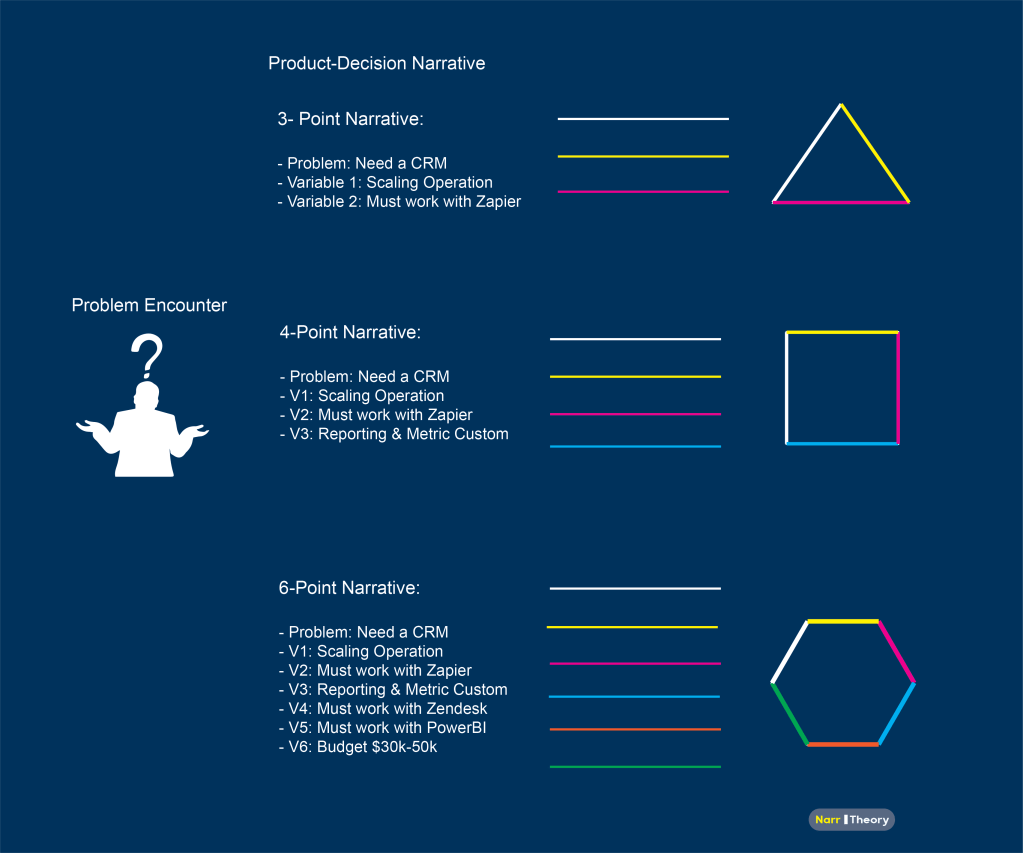
A person or organization encounters a challenge, identifies a need, and begins evaluating possible solutions. However, not all buying decisions are created equally. Some decisions are simple and involve only a few considerations, while others are shaped by a much larger set of requirements and constraints.
This is where Narrative Position becomes useful.
Understanding Decision Narratives
A decision narrative is the collection of variables that must be satisfied before a buyer can confidently move forward with a decision.
For example, a company may recognize that it needs a CRM platform. At first glance, this appears to be a straightforward requirement. However, the decision rarely stops there.
Additional variables begin to emerge:
- The CRM must support a growing operation.
- The CRM must integrate with Zapier.
- The CRM must provide custom reporting capabilities.
- The CRM must integrate with customer support systems.
- The CRM must work with existing business intelligence tools.
- The solution must fit within a defined budget.
Each additional requirement becomes another decision point within the narrative.
A purchase is only made when enough of these decision points have been satisfied.
Visualizing Narrative Depth
In the diagram above, each colored line represents a distinct variable within a decision narrative.
Each color represents a different consideration influencing the final decision. As more variables are introduced, the narrative becomes more complex and the decision structure gains additional anchor points.
A simple narrative may contain only three points:
- A problem
- Variable 1
- Variable 2
This creates a three-point narrative represented by a triangle.
As new requirements are introduced, the structure expands:
- Four points create a square.
- Six points create a hexagon.
- Additional variables continue to increase the complexity of the narrative.
The resulting shape is a visual representation of the overall decision structure.
Narrative Repetition and Narrative Expansion
Not every narrative is unique.
Many buyers share common variables, which is why some colors appear repeatedly throughout the diagram. These recurring variables represent common narratives that consistently influence purchasing decisions across multiple customers.
Other variables are more specialized and appear only within deeper or more advanced decision narratives. These additional requirements often emerge from specific workflows, industries, organizational structures, or operational constraints.
As narratives become more detailed, they become increasingly unique.
Using Narrative Position to Understand Your Market
Companies should analyze customer conversations, product evaluations, and purchase decisions through the lens of narrative depth.
Rather than viewing customers as a single audience segment, organizations can identify:
- Which decision narratives appear most frequently
- Which variables consistently influence purchasing behavior
- Which narratives the product already satisfies effectively
- Which narratives remain underserved
The goal is not simply to understand what customers buy.
The goal is to understand the narrative structure that led to the decision.
By identifying the narratives that are already producing successful outcomes, companies can double down on what is working. At the same time, they can identify narrative gaps and improve their ability to satisfy more complex or underserved decision narratives.
Narrative Position provides a framework for visualizing how decision complexity evolves, how buying requirements accumulate, and how products ultimately fit into the stories buyers are telling themselves when evaluating a solution.
Long-Tail Narratives
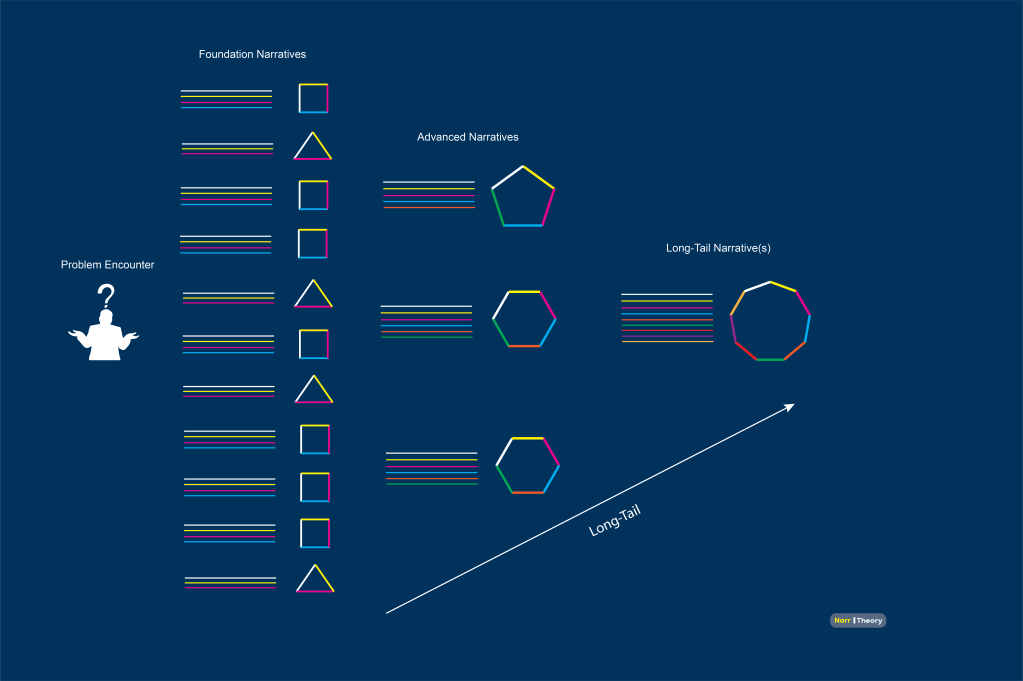
Not all decision narratives remain simple.
While some buyers evaluate products using only a small number of decision variables, others accumulate additional requirements, constraints, preferences, and contextual considerations throughout their decision-making process.
As these variables accumulate, narratives become increasingly specialized.
This is where long-tail narratives emerge.
Foundation Narratives to Long-Tail Narratives
In the previous model, we explored how decision narratives are constructed from individual variables.
A buyer may begin with a relatively simple narrative:
- Need a CRM
- Need scalability
- Need integration capabilities
This forms a foundation narrative.
Foundation narratives represent common and recurring patterns found across a market. Because they appear frequently, they are often shared by many different buyers facing similar problems.
However, decision-making rarely stops there.
As buyers continue evaluating solutions, additional variables are introduced:
- Existing software requirements
- Reporting requirements
- Compliance requirements
- Budget constraints
- Workflow considerations
- Stakeholder concerns
Each additional variable adds another layer to the decision narrative.
Narrative Evolution
Long-tail narratives do not typically emerge all at once.
Instead, they evolve.
A foundation narrative may expand into an advanced narrative as new requirements are introduced. Over time, additional variables continue to accumulate, producing increasingly specialized decision structures.
The result is a narrative that becomes more specific, more contextual, and less commonly shared by the broader market.
In other words, long-tail narratives are often built from the same foundational variables but arranged into increasingly unique combinations.
Narrative Building Blocks
One of the most important observations from this model is that many long-tail narratives are constructed from recurring narrative components.
Certain variables appear repeatedly across different buyers and different decision narratives.
For example:
- Integration requirements
- Reporting requirements
- Automation requirements
- Budget considerations
- Workflow constraints
These variables act as narrative building blocks.
The same building blocks can be combined in countless ways, creating a wide range of narrative structures across a market.
Understanding Market Complexity
Traditional market segmentation attempts to group buyers according to shared characteristics.
Narr Theory approaches the problem differently.
Rather than focusing solely on who buyers are, it examines the narratives that influence their decisions.
Some narratives are common and broadly shared.
Others become increasingly specialized as additional variables are introduced.
Together, these foundation, advanced, and long-tail narratives form the narrative landscape of a market.
Understanding that landscape allows organizations to identify which narratives are most common, which combinations occur most frequently, and where opportunities exist to better satisfy complex decision narratives.
The long tail is not composed of entirely different problems.
It is composed of increasingly unique combinations of narrative variables built upon a shared foundation.
Narrative-Product Position
Products do not exist in isolation.
They exist within the context of human activity.
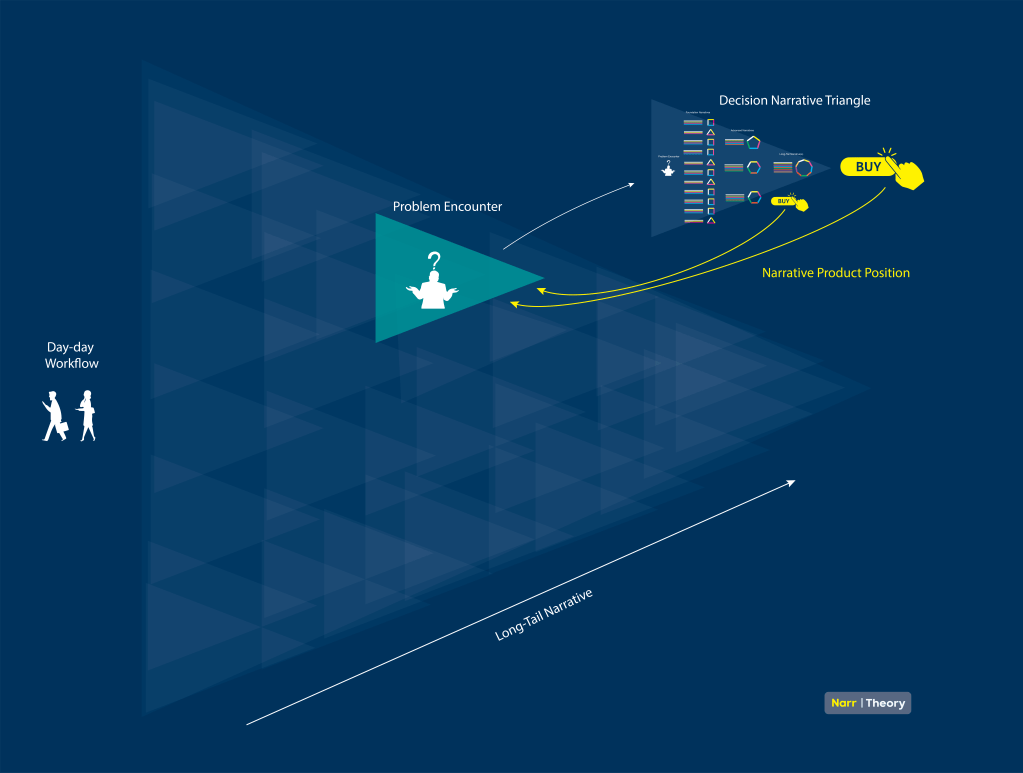
Every day, people move through a variety of workflows that make up their lives. Some of these workflows are professional, while others are personal. They may involve earning income, exercising, learning new skills, maintaining a home, pursuing hobbies, or managing relationships.
These workflows represent the day-to-day narratives that naturally occur throughout human life.
Most of the time, these workflows continue without interruption. However, sooner or later, people encounter friction.
A problem emerges.
A task becomes difficult.
An objective becomes harder to achieve.
A limitation is discovered.
This moment is what Narr Theory refers to as a Problem Encounter.
From Workflow to Problem Encounter
Problems do not appear randomly.
They emerge from existing workflows.
A person trying to improve their basketball performance may begin asking:
- How can I become a better shooter?
- How can I improve my conditioning?
- What training methods are most effective?
A homeowner may ask:
- How can I clean more efficiently?
- How can I reduce the time spent on household chores?
A business leader may ask:
- How can we scale operations more effectively?
- How can we improve customer management?
- What systems will help us grow?
Each question represents a problem encounter emerging from a specific workflow.
As individuals search for solutions, a decision narrative begins to form.
The Emergence of the Decision Narrative
Once a problem has been identified, people begin evaluating potential solutions.
For simple purchases, the decision narrative may be relatively straightforward.
For larger investments, however, the narrative often becomes more complex.
Additional variables begin to emerge:
- Cost considerations
- Integration requirements
- Time commitments
- Ease of use
- Performance expectations
- Compatibility with existing systems
As these variables accumulate, the buyer constructs a decision narrative that will ultimately guide the purchasing decision.
The more important the decision, the more likely the narrative will expand.
Understanding Narrative-Product Position
Narrative-Product Position refers to where a product sits within a buyer’s decision narrative.
Every product occupies a position relative to the variables that matter to the buyer.
Some products satisfy only a small portion of the narrative.
Others satisfy many of the variables but fail to address critical requirements.
The strongest products are those that align closely with the complete decision narrative being constructed by the buyer.
In other words, products do not compete solely on features.
They compete on their ability to satisfy the narratives that emerge from real-world workflows and problem encounters.
Why This Matters
As technology evolves, human workflows evolve alongside it.
The introduction of new technologies, such as artificial intelligence, changes how people work, learn, communicate, and solve problems. As workflows change, new problem encounters emerge.
These new problem encounters create new decision narratives.
For product teams, this presents an important opportunity.
Rather than beginning with features or technology, product development can begin with workflow analysis and problem discovery.
By understanding the workflows that people engage in every day, organizations can identify where friction exists, where problems emerge, and where new decision narratives are forming.
This creates a more natural path toward innovation.
Products Exist Within Narratives
Narr Theory suggests that products should not be viewed as isolated solutions.
They should be viewed as positions within decision narratives.
Those narratives emerge from problem encounters.
Problem encounters emerge from workflows.
And workflows emerge from the everyday activities that define human life.
Understanding where a product sits within that chain provides a deeper understanding of why people buy, how markets evolve, and where future opportunities are likely to emerge.
The Conclusion
The purpose of Narrative Position is not simply to understand how buyers make decisions.
The purpose is to understand where products sit within decisions.
Traditional market analysis often focuses on customer segments, demographics, industries, or product features. While these approaches can be useful, they do not always explain why two seemingly similar buyers arrive at different purchasing decisions.
Narr Theory proposes that decisions are guided by narratives.
As buyers encounter problems, they construct decision narratives composed of variables, constraints, requirements, and desired outcomes. The more complex the problem, the more complex the narrative often becomes.
For companies, this creates a different way of understanding the market.
Instead of asking:
- What features should we build?
- Which segment should we target?
- How do we differentiate from competitors?
Organizations can begin asking:
- Which narratives are most common within our market?
- Which decision variables appear most frequently?
- Which narratives are we satisfying effectively?
- Which narratives remain underserved?
By understanding the narratives that drive purchasing behavior, companies can identify where their products are positioned, where competitors are positioned, and where opportunities for innovation exist.
In this sense, Narrative Position transforms individual purchasing decisions into observable market patterns.
The goal is not merely to understand products.
The goal is to understand the narratives that determine whether those products are ultimately chosen.


 Narr Theory
Leave a comment