In the previous article, we explored the idea that products occupy positions within the narratives people live every day. The next question becomes:
How do we assess whether a product occupies a strong problem narrative position?
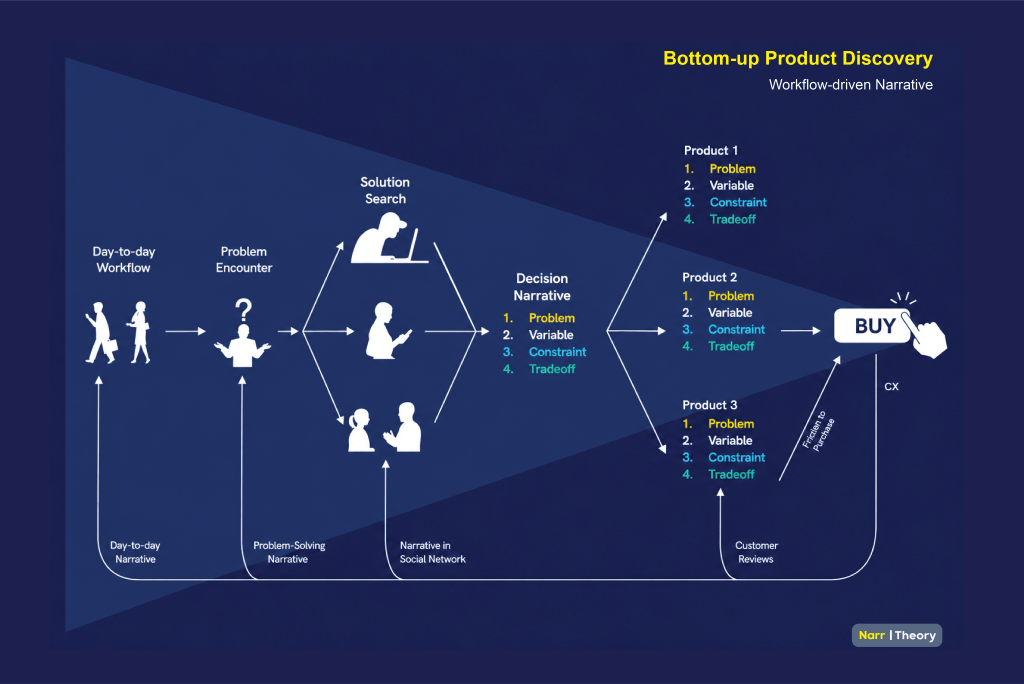
Using the Bottom-up Product Discovery model, we can evaluate a problem-product narrative position by examining a small number of important characteristics. Rather than attempting to categorize every type of problem, urgency driver, or alternative that exists, the goal is to identify the qualities that consistently strengthen or weaken a product’s position within a narrative.
1. The Problem Should Matter
The strongest narrative positions emerge when products address meaningful problems.
Ideally, these problems represent bottlenecks—situations that significantly interfere with a person’s ability to achieve a desired outcome.
However, bottlenecks are not the only valuable problems.
Problems that occur within day-to-day workflows can also create strong narrative positions.
Consider a refrigerator that is over twenty years old. The exterior is stained. Certain components are worn down. It carries a lingering smell that never quite disappears despite repeated cleaning.
Yet, it still works.
Food remains cold. The freezer functions properly.
Although problems exist, they may not create enough urgency to justify replacing the appliance.
However, context can change everything.
Suppose your fiancée’s parents are visiting your home for the first time.
Suddenly, the refrigerator becomes tied to identity.
The concern is no longer whether the refrigerator functions. The concern becomes:
“What does this say about me?”
The underlying problem remains the same.
The urgency changes.
This illustrates an important principle:
Problems do not exist independently of the narratives surrounding them.
The strongest problems often exist close to everyday workflows, lifestyle, identity, or bottlenecks that interrupt normal life.
2. The Problem Should Repeat
Repetition strengthens narrative position.
Many valuable problems arise because they occur repeatedly.
If a problem is embedded within daily workflows, repetition occurs naturally.
People must prepare meals.
People must commute.
People must communicate.
People must work.
However, repetition is not limited to essential activities.
A problem may emerge within hobbies, sports, creative pursuits, or leisure activities.
For example, someone who plays basketball every weekend may discover that their shoes consistently cause ankle pain.
Although basketball itself is not necessary for survival, the repeated occurrence of the problem may still create sufficient motivation to seek a better solution.
In general:
The more frequently a problem occurs, the greater the opportunity for products to establish meaningful positions within that narrative.
3. Easily Accessible Alternatives
Even when a problem is meaningful and recurring, products must contend with alternatives.
These alternatives are not always competitors.
Sometimes they are existing habits.
Sometimes they are older products.
Sometimes they are “good enough” solutions already within reach.
Imagine a toilet plunger that represents the most technologically advanced plunger ever created.
It requires minimal effort.
It prevents splashing.
It is lightweight and highly effective.
However, if consumers already possess a plunger capable of resolving the issue within a minute or two, the incentive to upgrade becomes much weaker.
The existence of accessible alternatives reduces urgency.
This is one reason why investors often value patents so highly.
Patents can reduce the availability of direct substitutes and strengthen a product’s position within a narrative.
The key question becomes:
“Can the customer easily solve this problem another way?”
If the answer is yes, the narrative position may be weaker than it initially appears.
4. The Nature of the Problem Must Align with the Solution
Perhaps the most important factor is the alignment between the nature of the problem and the nature of the proposed solution.
Technical superiority alone is insufficient.
A product must solve the right problem.
In 2021, during the COVID-19 pandemic, a company called Q4 invested heavily in developing software designed specifically for virtual investor conferences.
The logic seemed sound.
Investors could no longer meet in person.
Therefore, virtual conference software appeared to be the solution.
However, the company misunderstood the nature of the problem.
Investors have historically travelled significant distances to build relationships face-to-face.
Trust, social interaction, and in-person energy were fundamental components of these events.
The inability to meet physically was temporary.
The desire to meet physically was enduring.
Furthermore, banks had already adopted alternatives such as Zoom and were often reluctant to onboard new vendors due to cybersecurity concerns.
Although the product was technically capable, it failed to align with the deeper narrative driving investor behaviour.
The solution addressed the wrong problem.
A similar pattern emerged at QuestionPro.
The company continuously introduced new survey features, question types, and analytical capabilities.
Yet, market researchers were not primarily purchasing survey software.
They were purchasing expertise.
Organizations sought guidance on research design, participant recruitment, interpretation, and decision-making.
The software itself represented only one component of a much larger narrative.
By focusing heavily on technological advancement while overlooking the underlying intent behind the purchase, the company struggled to strengthen its position within the market.
In both examples, the challenge was not technical execution.
It was narrative misalignment.
Takeaway
Strong problem-product narrative positions are rarely accidental.
They tend to emerge when products address problems that:
- meaningfully affect people’s lives,
- occur repeatedly,
- lack sufficient alternatives, and
- align closely with the underlying nature of the problem being experienced.
Narr Theory proposes that products should not simply be evaluated according to their features.
They should be evaluated according to the narratives they seek to enter.
The better a product aligns with the realities of those narratives, the stronger its position becomes.


 Narr Theory
Leave a comment