
The below image is called the Basic Narrative Framework.
It depicts how people engage in day-to-day activities, encounter problems, and look for a solution. It is the basis of the Bottom-Up Product Discovery Model.
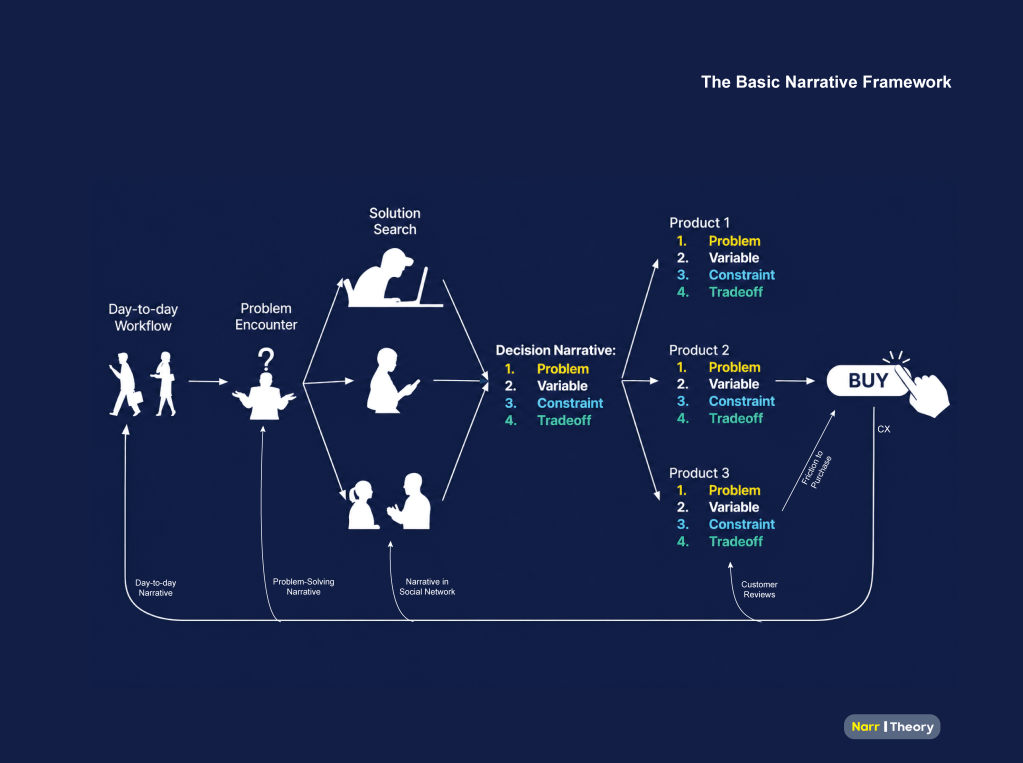
This is the basis for the Bottom-up Product Discovery Model.
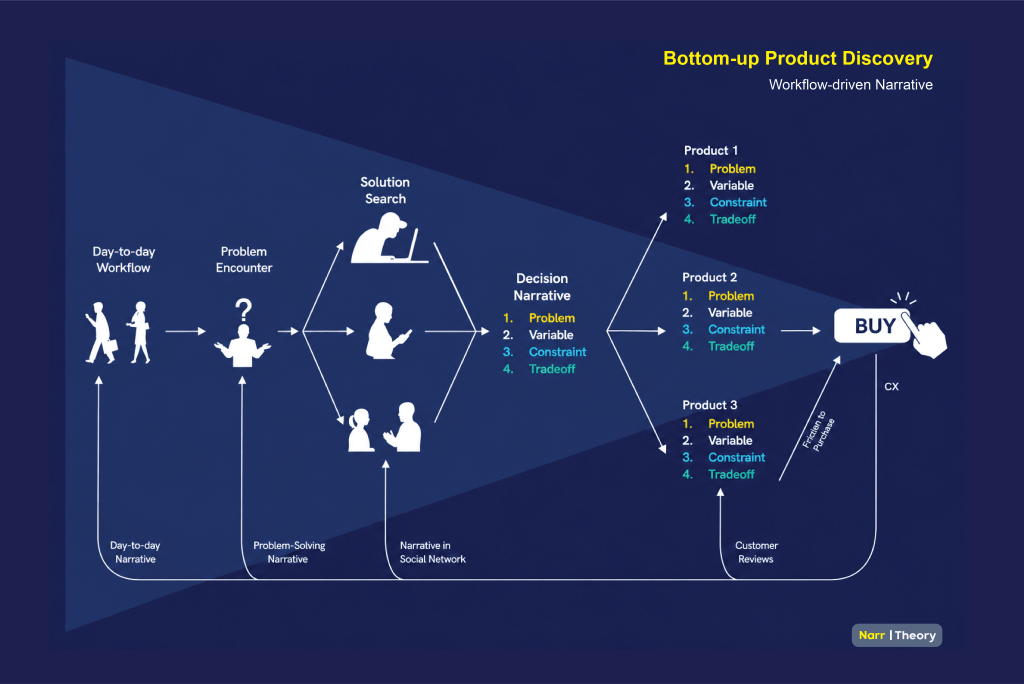
The Bottom-up Product Discovery Model
Traditional approaches to product development often begin with the product itself.
Companies ask questions such as:
- What features should we build?
- Who should we target?
- How do we differentiate from competitors?
Narr Theory proposes a different starting point.
Instead of beginning with the product, it begins with people.
More specifically, it begins with the narratives that naturally emerge from everyday life.
The Bottom-up Product Discovery Model is a framework for understanding how people move from their day-to-day activities toward discovering, evaluating, and ultimately purchasing products and services.
The Basic Narrative Framework
People move through countless workflows every day.
They prepare meals.
Commute to work.
Manage teams.
Exercise.
Raise children.
Study for exams.
Pursue hobbies.
Operate businesses.
These activities create the narratives that naturally occur throughout human life.
Most of the time, these workflows continue uninterrupted.
Until friction emerges.
Day-to-Day Workflow
Everyday life consists of activities that must be performed repeatedly over time.
Some workflows are professional.
Others are personal.
Some are essential to survival, while others relate to hobbies, leisure, and self-expression.
Regardless of the context, these workflows shape the narratives that guide our behavior.
They influence how we spend our time, what we prioritize, and ultimately what problems we encounter.
Problem Encounter
Problems do not appear in isolation.
They emerge from existing workflows.
A business may struggle to coordinate its growing operations.
A parent may realize their current vehicle no longer fits the needs of a growing family.
A homeowner may discover that their refrigerator has stopped working.
A person may receive an unexpected health diagnosis.
When a problem becomes meaningful enough, people become receptive to solutions.
This moment is referred to in Narr Theory as a Problem Encounter.
Solution Search
Once a problem has been encountered, people begin looking for ways to solve it.
Sometimes the answer already exists within their knowledge or social circles.
Other times, they actively search for solutions.
Importantly, people rarely search for products simply because they enjoy shopping.
They search because they are attempting to overcome an obstacle.
The search for a solution is often the search for progress.
Many meaningful purchases arise from this process.
The purchase is not the goal.
Progress is.
Decision Narrative
As people evaluate potential solutions, they begin constructing decision narratives.
These narratives consist of the variables, constraints, priorities, and trade-offs that shape the final decision.
Consider a family expecting a second child.
Their narrative may sound something like this:
We need more space.
We enjoy camping and outdoor activities.
The vehicle should be reliable and easy to maintain.
Ideally, any mechanic should be able to service it.
Our budget is between $50,000 and $70,000.
This is a decision narrative.
The deeper and more specific the narrative becomes, the fewer products are capable of satisfying it.
Narr Theory refers to this phenomenon as the Long-Tail Narrative.
Some narratives remain relatively simple:
I need the cheapest reliable vehicle available.
Others become increasingly complex as more variables emerge.
Regardless of complexity, products compete within these narratives.
Purchase
Eventually, a purchase decision is made.
A product is selected because it satisfies enough of the narrative to justify action.
Importantly, the “best” product does not always win.
The product that best aligns with the decision narrative often does.
People purchase at specific moments for specific reasons.
Understanding those reasons provides valuable insight into why products succeed or fail within their respective markets.
Narrative Feedback
The narrative does not end once a purchase has been made.
People experience the product.
They determine whether it fulfilled its promises.
They evaluate whether it was worth the money, time, and trust invested into it.
If the experience is positive, they may recommend it to others.
If the experience is negative, they may actively discourage others from choosing it.
These experiences feed back into future narratives.
Customer experiences become social narratives.
Social narratives influence future problem encounters.
Future problem encounters shape future decisions.
The cycle continues.
This feedback loop is one of the reasons why product quality, customer experience, and trust remain so important.
A product’s narrative position is strengthened or weakened by the experiences people have with it.
Why This Matters
Narr Theory suggests that products should not be viewed in isolation.
They should be understood within the narratives that lead people to discover them.
People generally seek to solve problems while expending the least amount of energy and effort possible.
They want products that work.
Recommendations they can trust.
Solutions that help them make progress.
Organizations that understand these narratives are better positioned to create products that align with real-world needs.
They can identify meaningful problems.
Recognize recurring patterns.
Understand how decisions are formed.
And improve how their products fit within the narratives people already experience.
The Bottom-up Perspective
The Bottom-up Product Discovery Model begins with everyday life.
Narratives emerge from workflows.
Problems emerge from narratives.
Solutions emerge from problems.
Decision narratives emerge from solution searches.
Purchases emerge from decision narratives.
Experiences feed back into future narratives.
Rather than asking:
What products should we build?
Narr Theory encourages us to ask:
What narratives already exist?
Because understanding the narratives that shape human behavior may reveal where the next products, opportunities, and innovations naturally belong.
The goal is not simply to understand products.
The goal is to understand the narratives that lead people to choose them.
In the articles below, we explore how products position themselves within narratives, how people discover solutions, why Points of Introduction matter, and how emerging technologies such as AI may reshape the future of narrative discovery.


 Narr Theory
Leave a comment