
In the previous articles, we explored how people move through day-to-day narratives, encounter problems, and search for solutions.
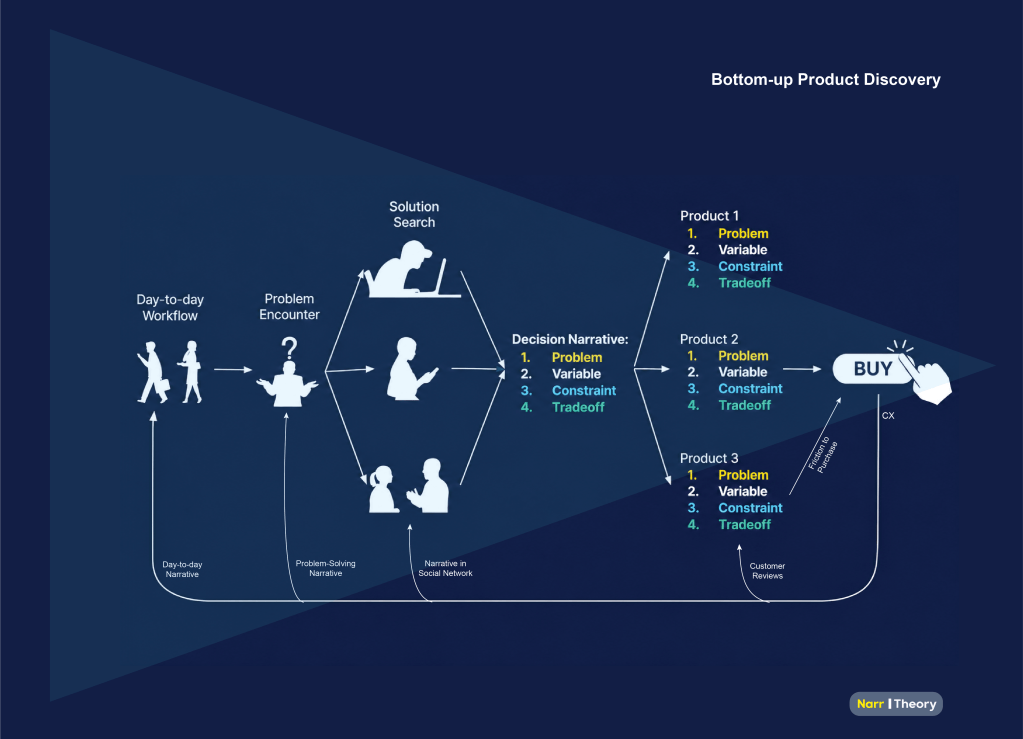
The next question becomes:
How do products enter those narratives in the first place?
Narr Theory refers to these moments as Point of Introduction.
A Point of Introduction is the moment at which a product naturally enters a person’s decision narrative.
Understanding these moments is important because people rarely wake up excited to solve problems.
People have jobs.
They have families.
They have hobbies.
They have responsibilities.
When a problem emerges, most people simply want to resolve it with the least amount of energy and effort possible so they can return to their lives.
Products that occupy stronger Points of Introduction reduce the amount of effort required to move from problem to solution.
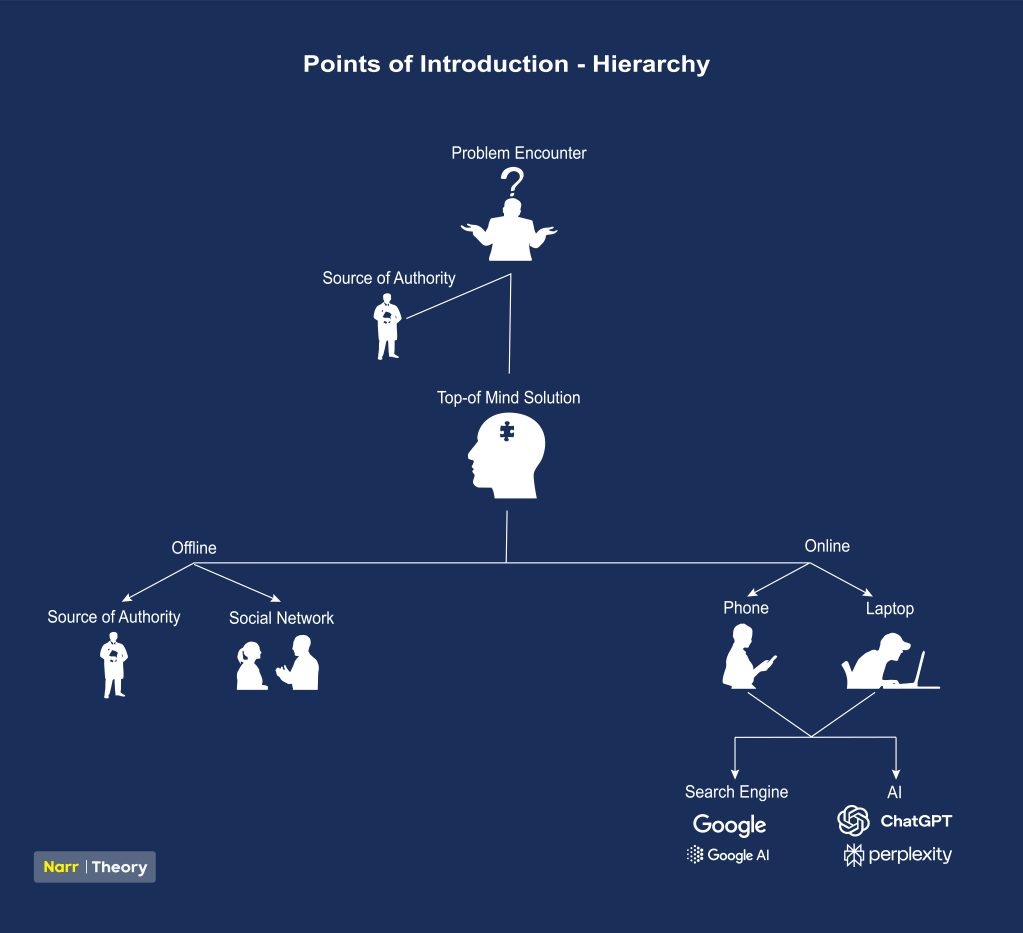
Underlying Premise
This hierarchy is based on a simple assumption: people prefer to expend the least amount of energy and effort possible while finding the quickest path to a solution.
Problem Encounter
The strongest Point of Introduction often occurs at the moment a problem becomes active.
For example, imagine visiting your doctor for a routine checkup.
The doctor informs you that your blood pressure is dangerously high.
Without lifestyle changes, serious health consequences may follow.
Suddenly, products and services that previously felt irrelevant become highly relevant.
- Gym memberships,
- Nutrition programs,
- Fitness applications,
- Heart health monitoring devices,
- Sleep tracking technologies.
The problem already existed.
What changed was the narrative.
The doctor’s diagnosis transformed a passive concern into an active problem.
The products entered the narrative at exactly the moment they became relevant.
Other examples include:
- A refrigerator stops working.
- A team misses an important deadline due to inefficient workflows.
- A vehicle breaks down unexpectedly.
In each case, the problem encounter creates urgency and increases receptiveness to solutions.
Source of Authority
Sometimes, the strongest introduction does not come directly from the problem itself.
It comes from a trusted source.
Doctors.
Mechanics.
Financial advisors.
Managers.
Coaches.
These individuals often diagnose problems before recommending solutions.
Their recommendations reduce the amount of effort required for people to evaluate alternatives on their own.
In many cases, products introduced through trusted authorities occupy exceptionally strong narrative positions.
For organizations, this raises an important question:
Who are the sources of authority within the narratives you serve?
Top of Mind
Not every introduction occurs at the exact moment a problem is encountered.
Sometimes, people simply remember.
They remember a brand.
They remember a recommendation.
They remember an idea.
People do not necessarily want to search.
They want to remember.
The fewer steps required to arrive at a solution, the better.
A parent planning a birthday party may immediately think of a particular venue.
A growing company may immediately think of a familiar software provider.
A homeowner experiencing plumbing issues may immediately recall the name of a trusted contractor.
This is mental availability.
The product has already secured a place within the narrative before the problem fully emerges.
Social Circles and Online Search
When people cannot immediately recall a solution, they often seek outside help.
This typically happens in one of two ways.
Social Circles
People ask others.
Friends.
Family members.
Coworkers.
Managers.
Industry peers.
The recommendation may not come from a formal authority, but social trust often plays a meaningful role in decision-making.
Online Search
Increasingly, people turn toward digital sources.
Historically, this process relied heavily on search engines.
A person might search:
“Best heart monitoring watch.”
or:
“Best CRM for small businesses.”
Today, however, search is evolving.
Artificial intelligence increasingly allows people to describe problems more naturally.
Instead of searching through keywords, people can describe their circumstances in narrative form.
For example:
“I recently visited my doctor because my blood pressure has been increasing. I need something that can help me monitor my heart health and encourage healthier habits.”
This distinction is important.
Traditional search often relies on keywords.
AI retrieval increasingly relies on narratives.
As a result, understanding the narratives surrounding products may become even more important in the future.
Ease of Accessibility
Sometimes, timing alone creates powerful Points of Introduction.
Imagine walking outside on an exceptionally hot summer day.
You and your children feel exhausted from the heat.
Suddenly, you hear the familiar melody of an approaching ice cream truck.
The problem is immediate.
The solution is visible.
The effort required to act is minimal.
This is another form of strong narrative positioning.
The product appears at exactly the moment it becomes desirable.
Why Points of Introduction Matter
Products do not succeed simply because they exist.
They succeed because they enter narratives at moments when people become receptive to them.
The strongest Points of Introduction often reduce the amount of effort required to move from problem to solution.
Sometimes this occurs through problem encounters.
Sometimes through trusted authorities.
Sometimes through mental availability.
Sometimes through social recommendations or digital discovery.
Narr Theory suggests that organizations should ask an important question:
Where are the Points of Introduction within the narratives we serve?
Because understanding how products enter narratives may be just as important as understanding the narratives themselves.
Products that occupy stronger Points of Introduction require less explanation.
Less persuasion.
Less friction.
They become easier to remember, easier to recommend, and easier to adopt.
Ultimately, the goal is not simply to build products.
The goal is to ensure that those products appear naturally at the moments people need them most.


 Narr Theory
Leave a comment