
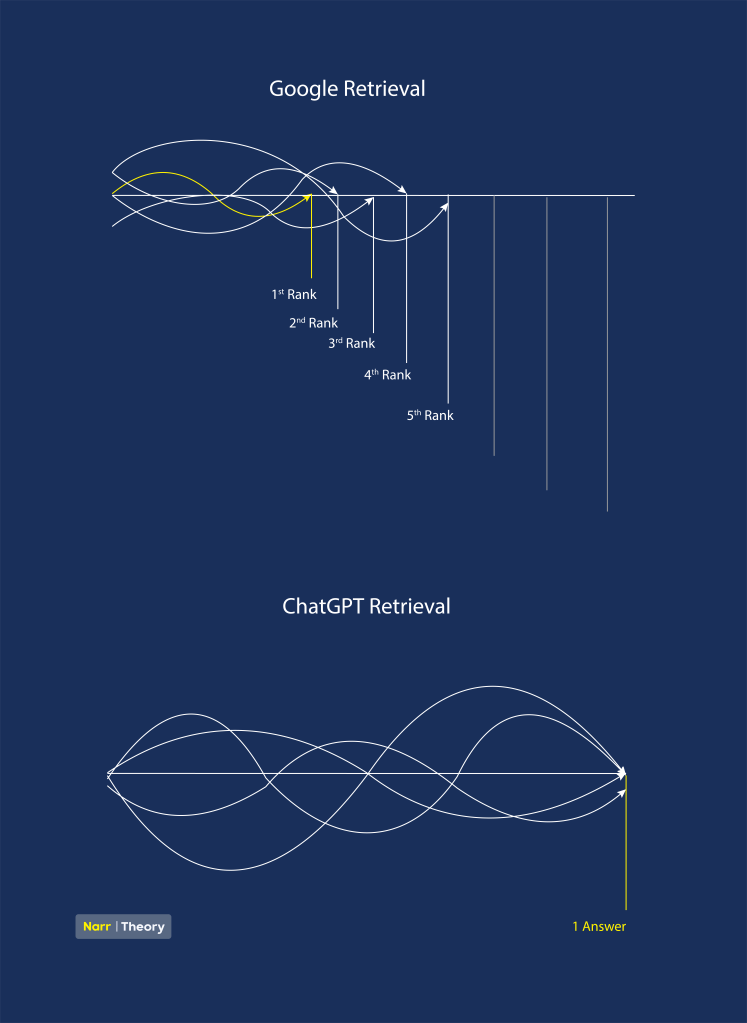
Google vs. ChatGPT Retrieval
As artificial intelligence continues to evolve, the distinction between Google and AI systems like ChatGPT is becoming increasingly important.
Traditionally, Google retrieval was understood as a ranking system.
A person entered keywords.
Google indexed webpages containing those keywords.
The most relevant pages appeared near the top of the results.
Today, however, Google is evolving beyond simple keyword matching.
Google increasingly attempts to understand the overall intent behind a search query.
Is the user trying to purchase something?
Are they looking for directions?
Are they researching a complex problem?
Are they seeking practical guidance?
Google’s introduction of AI-generated summaries at the top of many search results reflects this shift. Google’s objective remains the same: provide the best possible user experience by helping people reach useful answers as efficiently as possible.
ChatGPT approaches the same challenge differently.
As a large language model, ChatGPT is designed to understand natural language and generate responses directly. Rather than presenting a list of webpages, ChatGPT attempts to synthesize information into a single answer that addresses the overall narrative behind the question.
The important distinction is not that one understands narratives while the other does not.
Both systems increasingly attempt to understand the intent behind a query.
The difference lies in how retrieval occurs.
Google retrieval is primarily a ranking model.
Multiple sources compete for visibility, and users evaluate those options themselves.
ChatGPT retrieval is primarily a response model.
Information is synthesized into a recommendation or answer that attempts to satisfy the narrative directly.
This distinction has important implications for businesses.
Historically, organizations focused heavily on search engine optimization. The objective was straightforward: rank higher than competitors.
As conversational AI becomes increasingly embedded into everyday problem solving, a second challenge emerges.
It is no longer enough to simply rank.
Products must also become recommendable.
If a person’s narrative contains a specific set of problems, variables, constraints, and tradeoffs, organizations must understand whether their products are being surfaced within those responses.
In other words, the strategic question evolves from:
“How do we become the first result?”
to:
“How do we become the answer?”
This does not mean Google will disappear, nor does it mean ChatGPT will replace traditional search entirely.
Rather, retrieval itself is evolving.
As of June 2026, Google remains a dominant gateway for information discovery, while ChatGPT increasingly serves as a destination for problem solving and practical guidance.
Narr Theory suggests that organizations should pay attention to both.
Because regardless of the retrieval mechanism, the underlying objective remains remarkably similar:
People encounter problems.
People seek solutions.
And increasingly, technology attempts to understand the narratives that connect the two.


 Narr Theory
Leave a comment