
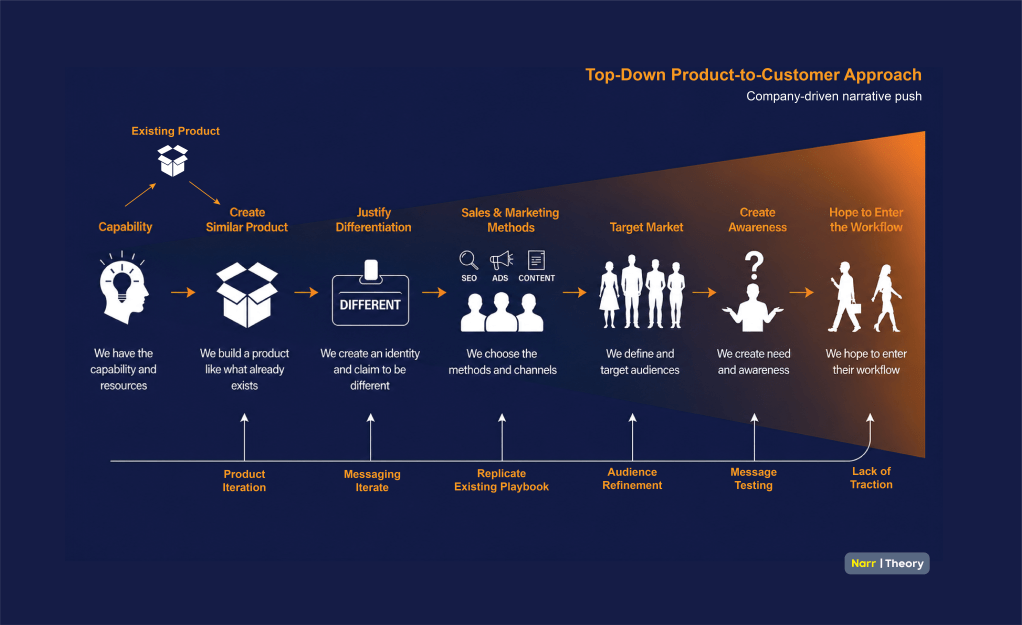
The Top-Down Product-to-Customer Approach
Not all products emerge from unmet needs.
Many products emerge because organizations possess the capability to build them.
They have engineers.
They have funding.
They have industry experience.
They have manufacturing capacity.
They have existing distribution channels.
In other words, they have the resources necessary to participate in a market.
The Top-Down Product-to-Customer Approach describes how many products are introduced into the world today.
Unlike the Bottom-up Product Discovery Model, which begins with human workflows and problem encounters, the Top-Down approach begins with the product itself.
New Product Created from Other Existing Products
Many product categories already contain successful examples.
Point-of-sale systems.
Survey software.
Project management tools.
Fitness applications.
Meal delivery services.
Organizations observe these categories and recognize an opportunity.
“This market already exists.”
“Customers are already buying these products.”
“We have the capability to build something similar.”
As a result, a new product enters the market.
Not because a new problem was discovered.
But because an existing opportunity was identified.
Justifying Differentiation
Once a similar product has been created, the next challenge becomes justification.
Why should someone choose this product instead of an existing alternative?
Organizations begin searching for points of differentiation.
Perhaps the interface is cleaner.
Perhaps the price is lower.
Perhaps the onboarding process is simpler.
Perhaps artificial intelligence has been added.
Sometimes these differentiators are meaningful.
Other times, they are merely attempts to justify existence within an already crowded category.
The important distinction is that the differentiation often emerges after the product has been developed.
Sales and Marketing Are Used
Because the product did not naturally emerge from an underserved narrative, additional effort is required to generate demand.
Organizations invest in:
- Search engine optimization,
- Content marketing,
- Paid advertising,
- Lead generation,
- Sales teams,
- Partnerships,
- Webinars,
- Conferences,
- Brand campaigns.
These activities are not inherently problematic.
However, they become increasingly necessary when the product lacks a naturally compelling reason to enter existing workflows.
Creating Awareness
As marketing efforts increase, organizations attempt to create awareness.
They define target audiences.
Refine messaging.
Test positioning statements.
Optimize conversion funnels.
The hope is that the product will eventually become relevant enough to enter the customer’s day-to-day workflow.
This is perhaps the most important observation within the Top-Down Product-to-Customer Approach:
Products are often created first and then seek narratives to belong to afterward.
Hoping to Enter the Workflow
People do not organize their lives around products.
They organize their lives around activities, goals, and problems.
They want to earn income.
Raise families.
Stay healthy.
Pursue hobbies.
Build businesses.
Strengthen relationships.
Products only become meaningful when they fit naturally within those narratives.
This is where many top-down products struggle.
Even with strong marketing, substantial investment, and large sales organizations, they still face an important question:
Why does this product deserve a place within someone’s existing workflow?
If the answer is unclear, adoption becomes increasingly difficult.
Why This Model Exists
The Top-Down Product-to-Customer Approach exists because there are economic incentives to participate in established markets.
Success attracts imitation.
A company observes another company’s success and attempts to replicate it.
If the capability exists, the product can be built.
If the product can be built, it can be marketed.
If it can be marketed, there is always hope that it will gain traction.
In this sense, the Top-Down approach is not irrational.
It is economically understandable.
However, it often creates significant noise within the marketplace.
Customers encounter advertisements that sound similar.
Products that appear interchangeable.
Messaging that lacks meaningful differentiation.
The result is increased competition for attention.
The Bottom-Up Alternative
The Bottom-up Product Discovery Model begins from a different premise.
People encounter problems through their day-to-day workflows.
Some of these problems become bottlenecks.
Others become recurring frustrations.
As people search for solutions, opportunities emerge.
Products developed from these opportunities possess a natural reason to exist because they originated from the narrative itself.
Rather than attempting to force their way into a workflow, they emerge from it.
Products Revolve Around People, Not The Opposite
People do not exist to justify products.
Products exist to support people.
This distinction sits at the center of Narr Theory.
The stronger a product’s connection to meaningful workflows, recurring problems, and existing narratives, the less friction it may encounter in adoption.
The weaker that connection becomes, the more organizations must rely on awareness campaigns, messaging refinement, and marketing investment to establish relevance.
Neither approach guarantees success.
However, Narr Theory proposes that products which emerge naturally from human narratives may possess an enduring advantage:
They already belong within the story people are living.
The challenge is not creating a narrative for the product.
The challenge is recognizing the narratives that already exist.


 Narr Theory
Leave a comment