
Why AI Retrieval Matters
When people encounter a problem they need to solve, they typically do one of two things:
They ask someone they trust.
Or they search online.
Increasingly, consumers are using AI not simply to find information, but to help solve problems.
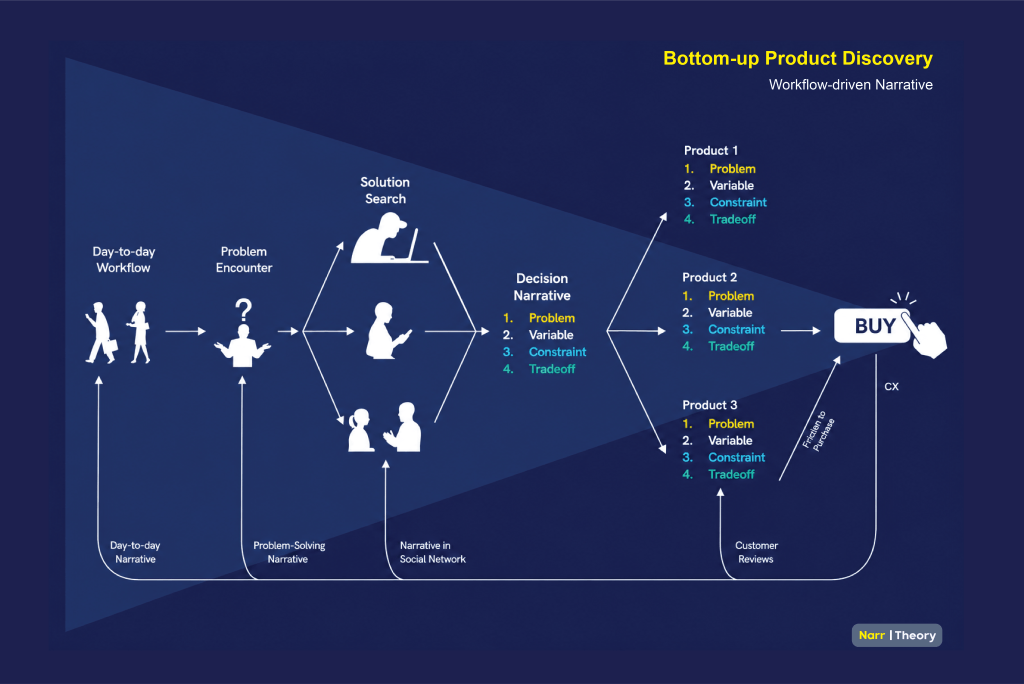
The distinction matters because some products are discovered through narratives, not keywords.
Traditional search engines remain highly effective for quick, transactional queries. If someone wants a burger nearby, directions, store hours, or a simple factual answer, Google and map-based retrieval systems continue to perform extremely well.
More complex problems, however, often involve multiple variables, constraints, and tradeoffs.
As of 2025, Google processes roughly 5 trillion searches annually, while ChatGPT reportedly handles approximately 2.5 billion prompts per day. Although Google remains significantly larger overall, conversational AI is increasingly becoming part of everyday decision-making.
The important signal is not that AI is replacing Google.
It is that consumers are allocating certain types of problems toward conversational systems.
Example: Buying a Family Car
Imagine John is expecting a second child.
He needs a vehicle with more space for his growing family. The car should also be fuel efficient for his daily commute, reliable to maintain, and easy for local mechanics to service.
Traditionally on Google, John might search:
“Best family SUV fuel efficient easy maintenance”
He would then browse multiple articles, compare recommendations, visit manufacturer websites, and piece together an answer himself.
Through ChatGPT, however, John can describe the situation naturally:
“I’m expecting a second child and need a larger vehicle for my family. I commute to work every day, so fuel efficiency matters. I’ve owned cars that were difficult and expensive to maintain, so I want something reliable that most mechanics can service easily. What would you recommend?”
This resembles how John might speak with a trusted friend or automotive expert.
Instead of sorting through numerous webpages, AI can immediately generate recommendations, explain tradeoffs, answer follow-up questions, and narrow options based on budget and priorities.
The narrative itself becomes the search query.
If your product satisfies the decision narrative criteria but is not being recommended, that represents an AI retrieval problem that should be addressed.
As consumers increasingly rely on AI to navigate complex decisions, organizations must understand how their products are being retrieved, described, and recommended within these systems.
Particularly for higher-investment purchases involving multiple decision variables, protecting and improving your AI narrative retrieval position may become as important as traditional search visibility.
If you would like to explore how AI systems recommend products in greater depth, we discuss this further in a later article.
In this next article, we discuss the key difference between Google and ChatGPT, with Google AI embedded as part of Google search.


 Narr Theory
Leave a comment