
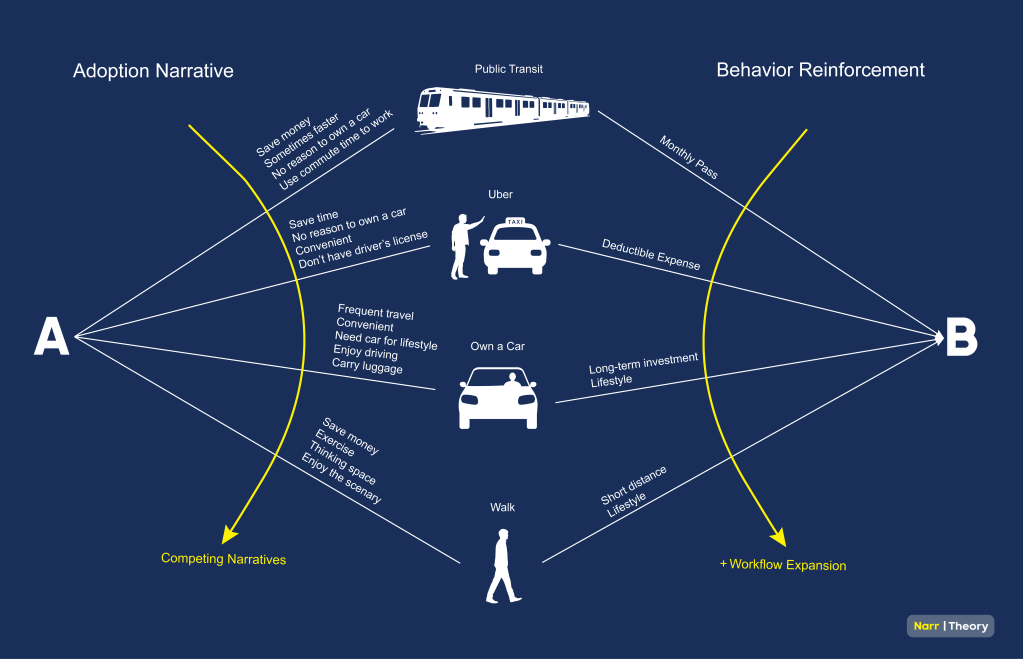
Workflow as a Destination Problem
Many everyday problems can be understood as a journey from Point A to Point B.
Sometimes this is a literal journey.
Suppose a person needs to commute thirty minutes from home to work. There are multiple ways to accomplish the exact same objective:
- Take public transit
- Take an Uber or taxi
- Own a car
- Walk
Each option reaches the same destination, yet each is justified through a different narrative.
Public transit may appeal to someone because it saves money. During the commute they can respond to emails, read, or simply avoid the responsibilities of owning a vehicle.
An Uber may resonate with someone who values convenience. They may not own a car, may not have a driver’s license, or simply prefer paying only when transportation is needed.
Owning a car may make sense for someone who frequently travels, enjoys driving, carries equipment, or views transportation as part of their lifestyle.
Walking may appeal to someone who enjoys exercise, likes having time to think, appreciates the scenery, or simply lives close enough that walking becomes the most enjoyable option.
The important observation is that each solution satisfies the same underlying need, but through a different narrative.
No solution is objectively superior.
They simply resonate with different people for different reasons.
Competing Narratives
One of the key ideas illustrated here is that solutions rarely compete on capability alone.
They compete through narratives.
The objective is identical: travel from Point A to Point B.
What differs is the justification behind each solution.
Some people value convenience.
Others value saving money.
Others prioritize lifestyle.
Others simply enjoy the process.
The person first subscribes to the narrative that best fits their situation, values, and day-to-day workflow.
This is why one solution is rarely objectively better than another.
A person who enjoys walking is unlikely to resonate with owning a car for the same reasons that someone who frequently travels may find walking impractical. Both solutions accomplish the same objective, but each is justified through a different narrative.
Understanding these competing narratives is often more valuable than asking which product is “better.”
The better question is:
Which narrative does this individual naturally subscribe to?
Behavior Reinforcement
Once a person subscribes to a narrative, they take action.
That action becomes behavior.
If the experience reinforces the original narrative, the behavior becomes increasingly embedded within the person’s day-to-day workflow.
Someone who consistently enjoys public transit may purchase a monthly pass.
Someone who frequently uses Uber may begin relying on it for business travel or deduct transportation expenses.
Someone who owns a car reinforces that decision every time they drive for work, leisure, or weekend trips. Over time, the purchase becomes part of their lifestyle rather than simply a transportation choice.
Walking only becomes a reinforced behavior if it naturally fits the individual’s workflow. A pleasant thirty-minute walk may become a daily habit, while a two-hour walk is unlikely to sustain itself regardless of how appealing it initially seemed.
This illustrates an important principle within Narr Theory:
Narrative precedes behavior.
Behavior only becomes reinforced when the chosen solution consistently delivers on the narrative that justified its adoption.
If excessive friction is introduced, people are far less likely to continue subscribing to that workflow.
Workflow Expansion
Once a behavior becomes part of someone’s workflow, it naturally creates new needs.
The original decision rarely exists in isolation.
Someone who regularly takes public transit may eventually purchase a monthly pass, an umbrella, headphones, or a backpack designed for commuting.
Someone who frequently uses Uber may begin considering personal safety while waiting for rides or business travel reimbursement.
Someone who owns a car now requires insurance, maintenance, fuel, parking, and accessories.
Someone who walks regularly may purchase comfortable shoes, a water bottle, or weather-appropriate clothing.
The original transportation decision expands into an ecosystem of related products and services.
This is why understanding workflow adoption matters.
Products are rarely the final destination.
They become part of an expanding workflow that creates new behaviors, new decisions, and entirely new opportunities for other products to enter the narrative.
Although transportation provides a simple illustration, the same principle applies across countless human workflows. People do not merely adopt products—they adopt narratives. Once those narratives become reinforced through repeated behavior, entirely new workflows emerge around them.
To identify a product’s positioning in the competing narratives, the following article is a great resource to leverage:

 Narr Theory
Leave a comment